The AI Redesign: The Hub
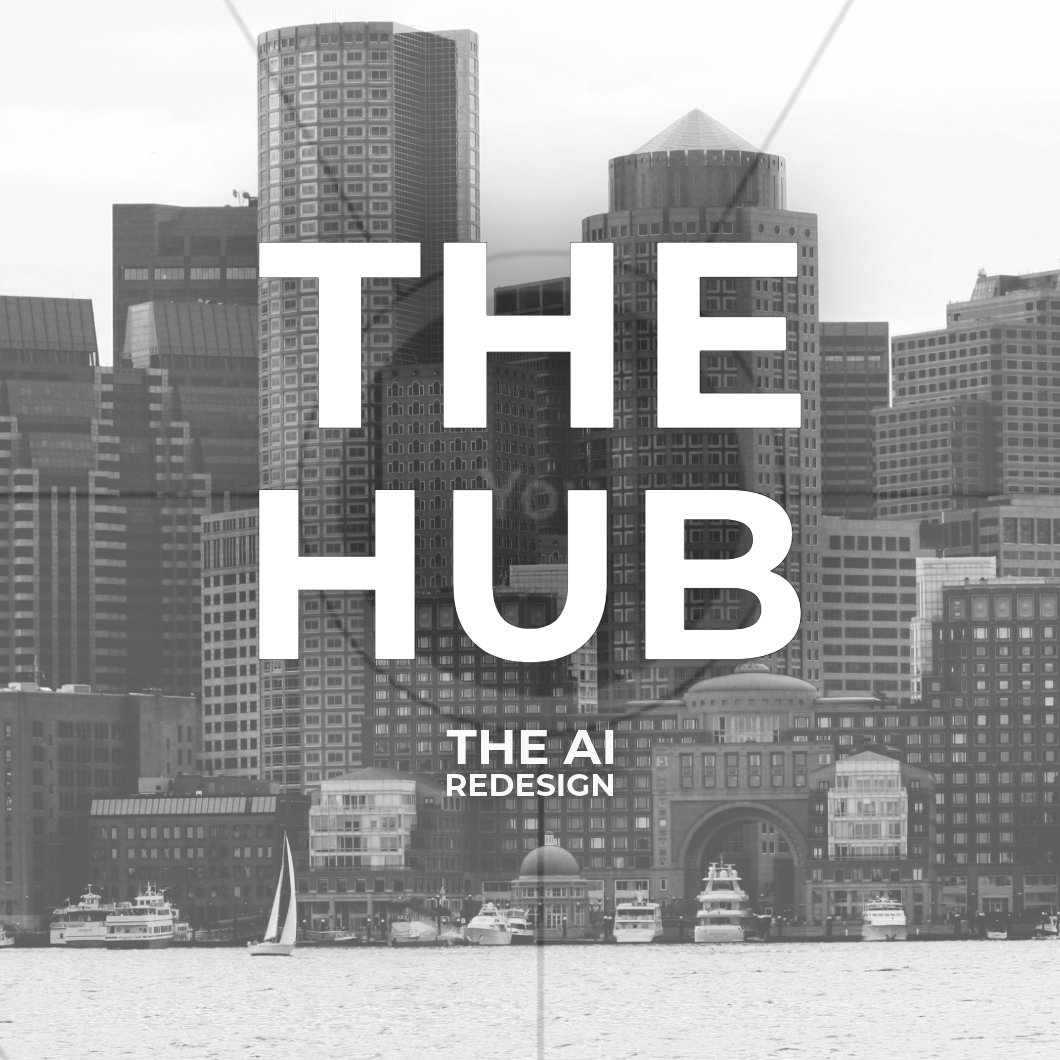
Boston Photo by David Trinks on Unsplash
AI is compressing hierarchy. The Hub is a post-AI structure for founder-led companies that need coherence without bureaucracy.
Once again, over the last few weeks, the business section of your favorite online news resource has been replete with bold, blaring doom-mongering:
TECH GIANT UNLEASHES HELLSCAPE BLOODBATH LAYOFFS
or:
BILLIONAIRE TECH-BRO FOUNDER PREDICTS WHITE-COLLAR DYSTOPIAN MASS UNEMPLOYMENT
or some corporate seer announcing that by 2030 every department will be "AI-powered," whatever fresh hell that means.
If you have become panicked by these satirical examples…
Breathe.
AI will transform work. Its effects will be staggering: economically, socially, culturally, and perhaps even in how human beings understand themselves as human beings.
But panic is usually the least interesting part of a technological age.
Technology has always reorganized more than work. The wheel, the cotton gin, the assembly line, the computer, the internet…
All of it rearranged power, labor, status, comfort, and fear.
So yes, the AI panic has an undercurrent of truth. But beneath the panic, something more structural is happening…
The hierarchy is being questioned.
For decades, the modern white-collar workforce was built around the coordination of so-called "complex systems." Middle-management layers emerged to relay information, translate strategy, approve decisions, maintain operational flow, and make the increasingly abstract machine of corporate life appear…
Manageable.
Corporate life became an endless circulation of email chains, slide decks, reports, dashboards, and those absurdist, Dilbert-esque meetings about meetings. And Zoom calls about the dashboard created to summarize the meeting about the meeting.
Entire professional ecosystems evolved around the processing of information through increasingly bloated organizational structures.
We told ourselves this was intelligent work, performed by intelligent people performing intelligent tasks, optimizing the friction of organizational complexity.
But was it? Or was much of it simply the performance of importance inside a structure that had become too distant from the work itself?
The modern corporate hierarchy promised economic security, career advancement, and a visible ladder toward professional meaning. For many people, it delivered something else: soulless stagnation, managerial theater, dashboards glowing with false clarity, spreadsheets no one trusted, and profits that somehow never managed to trickle down from the shareholder-c-suite lounge.
No wonder so many people became disconnected, disinterested, and indifferent.
They did not simply hate work…
They hated being structurally irrelevant.
And now, AI has emerged.
AI will eliminate jobs. But that is the loudest and least useful version of AI's evolutionary timeline.
Instead, AI will eliminate the bloated bureaucratic layers built around endless swirls of information.
The old middle manager—the academically credentialed "Leader" whose authority was premised on dashboards, status meetings, strategic updates, forwarded emails, and tidy little memos of selfish importance—will become much harder to justify.
AI can compress, compile, summarize, circulate, and digest that information with terrifying ease.
The work this person once existed to manage can now move with fewer intermediaries.
That version of management will disappear…
Vanished like some mid-century caricature of The Man in the Gray Flannel Suit.
There will be less marrow and fat now. Less administrative padding. Less room to equivocate.
For founders, builders, and leadership teams entering the AI era, this creates a deeper question:
If the old hierarchy was built on distance, control, and endless swirls of information, what replaces it?
How does a founder create structure without recreating the desiccated values of the previous corporate order? How can a new, relational, collaborative approach emerge without devolving into the dispiriting, transparent, jargon-laden leadership culture of this dying age?
And how does it avoid becoming some flat, hippie commune-esque structure from an 1980s Big Sur New Age cult—but with a bespoke, vibe-coded CRM?
The answer is not the pyramid or a tie-dyed commune…
It is The Hub.
The Hub
Close your eyes and envision the iconic Boston Bruins logo.
This is not an exercise in sports knowledge. Nor some cliché Boston sports joke where a bunch of locals sippin' their Dunks engage in a self-indulgent, tedious shouting match over Original Six iconography.
No.
Just envision that logo with its letter B…
A center
A wheel
Spokes radiating outward
A rim holding the whole thing together in motion
The image works because Boston has long carried that idea inside its civic mythology: the city as hub, as routing system, as center of movement. All that energy of trade, work, culture, money, ambition, resentment, Brahmin ghosts, triple-deckah’s, hospitals, universities, ports, tunnels, The T, old money, new money, Irish Catholic melancholy, biotech optimism, and lobster rolls priced like late-1990s complex financial instruments…
Inbound
Outbound
All of that energy coursing through a central point.
That is why the image matters. The B is not merely a letter; it is a center of gravity. The spokes are not decoration; they are avenues of movement. The circle is not ornament; it is containment, return, and continuity.
And for the founder entering the AI era, that image begins to say something the old corporate pyramid cannot.
The founder is not the boss at the top. The founder is not the celebrity visionary held aloft by their own buoyant arrogance, flying across the earthly plane to lecture the business masses about disruption while their own company suffers from the mess of their leadership vacuum.
But let's pause before The Hub becomes another dangerous metaphor for celebrity visionaries and personal-brand founders to exploit.
Taken too literally, the hub becomes another form of founder dependency. Every idea routes back to the founder. Every decision waits for the founder. Every uncertainty searches for the founder's mood, taste, approval, energy, or interpretation before it can move.
The company becomes smaller, faster, more AI-enabled…
And still somehow trapped inside one person.
That is not a hub.
That is an egocentric bottleneck with better branding.
The founder may be the center, but the center is not the whole shape.
This is the distinction the post-AI organization has to reckon with. The goal is not to remove hierarchy and then route every aspect of the business back onto the founder's desk like some ceremonial offering to the village oracle.
The goal is coherence.
People. Processes. Craft. Culture. Creativity.
Those are not separate business problems or quarterly initiatives waiting to be addressed.
Instead, they are living—
Relationships.
People and Processes are always speaking to each other, whether leadership admits it or not. Hire someone without understanding how the work actually unfolds, and the mistake will eventually appear somewhere on a Tuesday afternoon, usually inside a process everyone despises but nobody has had the courage to call out. Build a process without understanding how people work inside and the process becomes theater. It will be followed when leadership is watching, ignored when reality arrives, and quietly resented by the people who know exactly where the structure is lying.
Craft and Culture are also in constant relationship.
Culture without craft is just…
Vibes.
A few values on the website. An in-house cafe. A few approved phrases about belonging, ownership, and excellence floating through the company like air freshener sprayed over rot.
Craft without culture is one talented person alone in the corner, holding the standard by sheer force of will until resentment, exhaustion, or better compensation finally propels them out the door.
And Creativity is the current beneath the hub.
Not creativity as your teenage mood-board. Not creativity as the founder's private genius…
But creativity as force: impulse, pressure—that charge.
That strange generative energy that makes a founder build something in the first place and then keeps pushing the business beyond whatever structure originally held it.
This is why Creativity belongs in The Hub. A founder-led company is not merely administering work; it is converting creative energy into something tangible for other people to build upon.
Without People, creativity stays trapped inside the founder's head, where it becomes fantasy, frustration, or another half-formed idea nobody else can touch and test.
Without Processes, creativity becomes a gigantic, messy sprawl. The company chases every glimmering idea, opens every tab, starts every initiative, and mistakes constant, swirling motion for creation.
Without Craft, creativity becomes indulgence. Interesting, probably. Exciting, maybe. But unfinished, undisciplined, and unworthy of the founder's original standard.
Without Culture, creativity becomes either chaos or fear. Either everyone launches ideas into the room until decision-making is saturated with noise, or no one has the courage to stand up, raise a hand, and say the necessary thing because the company has quietly conditioned them to never risk consensus.
This is what the old org chart could never really see—or allow to develop.
The pyramid separated these forces into departments, layers, titles, reporting lines, and leadership rituals. People in that office. Processes in that department. Culture somewhere in HR, trapped inside a proprietary values deck, or quietly weaponized into a Performance Improvement Plan. Craft? That nebulous philosophy floated over to the one person who still cared enough to be annoying about the standard. Creativity was dangerous, so it was disguised as a "breakout session" that was really a bullet-pointed assignment to brainstorm and "flesh out" the corner-office executive's latest, lamest campaign or the founder's newest champagne-hangover idea.
Eventually, whatever authentic direction existed at the center was translated downward until it arrived as some soulless slogan nobody believed but everyone recited because, well…
Compliance and conformity.
The flat structure did not solve this either.
The flat structure saw the old hierarchical pyramid as distance, control, abstraction, and professional irrelevance. And, for the most part, it was correct. But, like most youthful anarchist types, its reaction was extreme: no bosses, no authority, no merit, no center, and no structural framework whatsoever.
But just because you sprinkle unicorn kisses and tie-dye on an org chart does not make it friendly. Or more equal.
It simply devolves into atmosphere…
Feelings.
Vibes.
Old-school Boomer primal scream therapy.
Or worse…
Struggle sessions.
A flat structure without grounded management, leadership, or stewardship becomes a toxic miasma of social pressure, moods, passive consensus, hidden influence, and the cult of charisma: the loudest voice, the founder's sneaky unspoken preferences, and the team's fear of speaking against the obvious forces destroying the work.
And inside this miasma, creativity withers.
The Hub is not the pyramid or the commune.
It is a structure of routed coherence.
The founder holds the center, but not to control every moving aspect. The founder maintains the center to keep the relationships alive: People to Processes, Craft to Culture, Culture to Creativity, Creativity back to People, Process back to Craft.
This is not some sequential framework, checklist, or process to be developed this quarter, next quarter, when the budget allows, or during some creative retreat. That is exactly how companies drift while appearing very busy and creatively engaged.
The Hub requires the founder to remain close enough to feel, listen, and detect when those relationships begin to quiet, fray, or stagnate. When hiring has become detached from the actual work. When people and processes no longer understand one another. When culture has lapsed from the standard. When craft no longer resembles the reality of the business. When creativity has become separated from responsibility…
And this is why AI's power of compression becomes useful instead of merely threatening.
The old middle manager often existed to bridge gaps the structure itself had created: summarizing, translating, relaying, and making information legible because people and processes were no longer allowed to speak directly.
AI can summarize, synthesize, translate, and relay much of that information instantly.
And…
Awesome.
But AI cannot decide what the standard is. AI cannot sense when culture has rotted and gone hollow. AI cannot feel when the processes are exhausting the people.
And during those Zoom meetings, AI—as of yet—cannot stare into a set of eyes and understand that the project has stalled not because of capacity, but because no one has voiced the uncomfortable fear inside the room.
All of that remains human. Distinctly human to human.
That is why The Hub is not merely an information structure.
It is a human structure.
A structure for keeping People, Processes, Craft, Culture, and Creativity in living relationship before the business collapses back into bureaucracy, founder dependency, or vibes.
That is the work.
Not control…
Coherence.
As The Company Grows
"Yeah…but this is idealistic. What happens as my company grows?"
Of course, someone will eventually ask the boringly practical question.
And that's cool.
The Hub works when the company is small because everything is still close enough to touch. The founder can hear the tone, feel the strain, notice when a process is dying, dead, or lying to everyone involved, and retain that uncanny intuition for when a candidate looks excellent on the screen but does not fit the people, the culture, or the actual work.
And real creativity still has proximity to the structure. It has not yet become another beautiful idea wandering around the company looking for a process strong enough to support it.
But what happens at fifty people? What happens when the company becomes remote and stretches across time zones, screens, Slack channels, dashboards, documents, project-management tools, and all the strange little digital systems that now constitute professional life?
What happens when the founder can no longer feel every tremor in the structure?
That is the issue.
Not size alone…
Distance.
As the company grows, the line between the founder and the outer edge stretches. Meaning has farther to travel. Intent has more rooms to pass through. The signal becomes easier to repeat and harder to understand.
The phrase survives. The initiative survives. The direction survives…
But the meaning does not. The founder's intent can be repeated perfectly and still be understood poorly.
Information moved, but fidelity did not.
And when fidelity begins to weaken, many companies panic.
And by panic, I mean they transform into Respectability.
They add layers. They hire managers. They bring in that "adulting consultant" with an impressive array of operational vocabulary and a suspiciously refined ability to say absolutely nothing for eleven consecutive minutes during a leadership meeting.
The company grows, so it adds management; management necessitates additional management meetings; meetings spawn more dashboards; dashboards produce another layer of specialized management to interpret the dashboards.
And at this point, the founder stares up from their laptop and realizes the company has recreated the same desiccated structure it once believed itself too creative, interesting, and cutting-edge to become.
The old hierarchy returns wearing a tech vest and "vintage" Allbirds.
That is not growth.
That is imported bureaucratic abstraction.
The Hub does not scale by making the founder bigger.
It scales by transferring coherence.
One center cannot hold every question forever. Every fear, ambiguity, decision, creative impulse, and quiet distortion in meaning cannot keep returning to the same exhausted point.
The spoke cannot stretch forever. So the spoke…
Splits.
Another center forms along the line.
Another, smaller B.
Not a competing power center. Not a middle manager in disguise.
This smaller B is a steward node.
A smaller hub.
Not a manager of work, but a carrier of coherence.
This person is not installed. They're cultivated.
The new B does not arrive with a polished résumé and a mandate to professionalize the team. They are recognized inside the work and inside the company.
They have absorbed the founder's standard, but they also understand the company as it actually lives: the people, the pressure, the rhythm, the craft, the quiet tensions, the strange little truths no onboarding document will ever capture.
They know what the company is protecting. They know what the process is supposed to serve. They know what kind of pressure is useful, and what kind of pressure is merely institutional noise dressed as urgency.
They are not elevated because they want authority, but because they are trusted.
This is transfer: the real movement of living judgment, craft, ethos, creativity, direction, and responsibility from one human being into another.
The steward node has a different function: it does not sit above the work; it stands inside it. Close enough to know what is actually happening. Close enough to know what the founder's standard requires. Close enough to notice when the words are right, but the meaning has evaporated.
A steward knows when a good hire is being ruined by a faulty process. When a process works on paper and lies in practice. When collaboration has become avoidance. When "being flexible" has become a polite way of abandoning craft.
A steward understands creativity too, but not as novelty, brainstorms, or the founder's sacred chaos. Creativity is charge. Direction gives it movement. Craft keeps it honest. People and Processes make it real.
A steward knows when an idea has energy but no coherent shape, when an initiative is necessary, and when it is just a beautiful way to avoid the difficult challenges already facing the company. They know when the founder's creative impulse needs protection, and when it needs translation.
They also know when the team is not resisting change because they are lazy, unimaginative, or allergic to brilliance, but because the idea has not yet been shaped properly for them to execute and evolve.
That is stewardship. Not answering every question. Not becoming the founder's interpreter-priest. An not contorting a smaller B into a smaller throne.
That is how The Hub grows. Not through more layers, but through distributed stewardship.
The old middle manager stood between the work and the decision. The new steward stands inside the work, close enough to keep the decision connected to reality.
This matters even more when the company becomes remote, because remote work creates distance. Sometimes humane distance. Sometimes useful distance. Sometimes the blessed distance from fluorescent lighting and the peculiar office ritual of confusing productivity with bodies sitting behind expensive desks.
But distance is still distance. And distance requires stronger stewardship.
Transfer has to become intentional: face to face, camera to camera, voice to voice, human to human.
Someone has to remain close enough to the people and the work to know what the dashboard cannot tabulate, compile, summarize, or understand.
The dashboard can show velocity…
It cannot always show a team's depletion.
The report can show completion…
It cannot show confusion.
That is why the steward matters. Not because they have better data, but because they are close enough to reality to know when the data cannot translate the truth.
This is where the future middle manager either becomes useful or disappears.
The old middle manager was often a relay.
The future middle steward is a reader of reality. Not management as distance—but stewardship as proximity.
But even this can decay. Every structure can decay. Even The Hub.
A steward node can become a gatekeeper. A local hub can become a local bottleneck. A person trusted with coherence can begin mistaking their judgment for ownership. The smaller B can forget it exists in relation to the larger shape.
This is why the founder's work does not shrink as the company grows…
It changes.
The founder becomes the steward of stewards: the one who protects the original center while cultivating smaller centers strong enough to convey the work without becoming little kingdoms of their own.
Stewardship is not status—
The new B is not given authority to become important. The new B is given responsibility to keep the work coherent.
When the company grows, The Hub does not disappear…
It becomes more demanding.
The founder must transfer judgment without abandoning the center. The stewards must embody authority without becoming distant and abstract. The team must gain autonomy without dissolving into chaos. AI must not becoming the culture.
A maturing company does not abandon The Hub…
It learns how to reproduce coherence without reproducing bureaucracy.
The Hub is not a preset framework. It is a way to examine how a founder-led company actually holds coherence: where responsibility concentrates, where meaning gets distorted, where creativity loses structure, and where stewardship needs to be transferred.
If your company is growing, but the structure no longer feels connected to the work, NorthBreak helps you recover the shape before complexity hardens into bureaucracy.